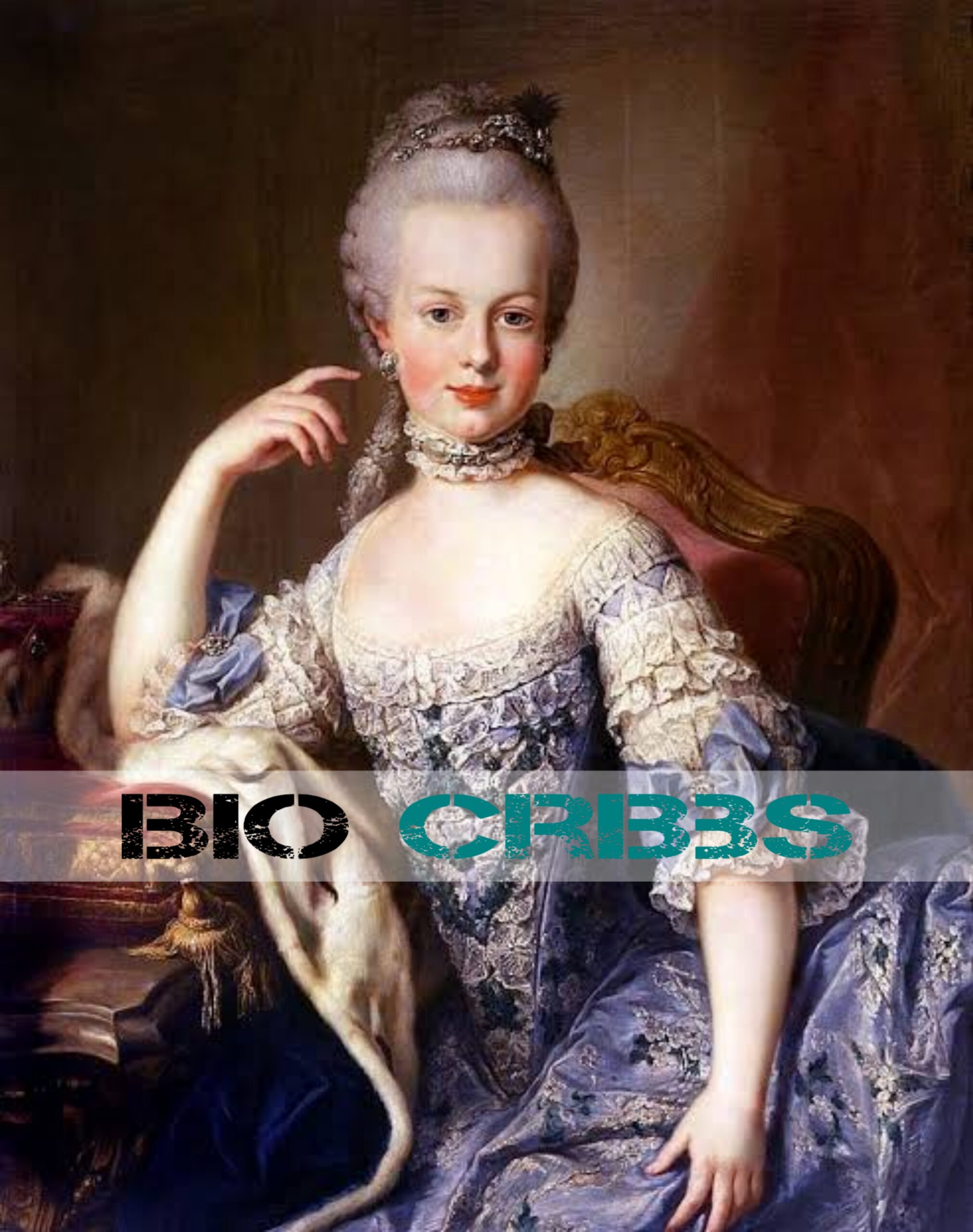

Marie Antoinette was born on November 2, 1755, in Vienna, Austria. She died on October 16, 1793, in Paris, France, at the age of 37.
Also Read: Horace Mann Biography: The Complete Account, Verified Records & Legacy
She was the youngest daughter of Empress Maria Theresa and Emperor Francis I of the Holy Roman Empire. As a child, she lived in the Hofburg Palace and received a basic education focused on religion, music, and court manners. Her early life was shaped by royal customs and political expectations.
At age 14, she married Louis-Auguste, the future King Louis XVI of France. The marriage was arranged to strengthen ties between Austria and France. She moved to Versailles and became queen in 1774 when her husband took the throne. At just 18, she became one of the most powerful women in Europe.
As queen, Marie Antoinette lived a lavish lifestyle. She wore expensive clothes, hosted grand parties, and built private retreats like the Petit Trianon. Her spending drew criticism, especially during France’s financial crisis. Many blamed her for the country’s problems and called her “Madame Déficit.”
Despite the backlash, she supported the arts and helped improve fashion and design in France. She also tried to influence politics, though her efforts were often seen as harmful. Her image suffered further after the Diamond Necklace Affair, a scandal she was wrongly linked to.
When the French Revolution began in 1789, her life changed. The royal family was forced to leave Versailles and live under watch in Paris. In 1791, they tried to escape but were caught. This failed attempt made her more unpopular.
In 1792, the monarchy was abolished. Louis XVI was executed in January 1793. Marie Antoinette was imprisoned, tried for treason, and sentenced to death. She was executed by guillotine on October 16, 1793, at the Place de la Révolution.
Marie Antoinette’s life was marked by privilege, controversy, and tragedy. She became a symbol of royal excess but was also a victim of political unrest. Today, historians view her with more nuance, recognizing both her flaws and the pressures she faced as queen during a time of great change.
Marie Antoinette Early Life and Royal Lineage
Marie Antoinette was born Maria Antonia Josepha Johanna on November 2, 1755, in Vienna, Austria. She was the fifteenth and penultimate child born to Empress Maria Theresa and Francis I, Holy Roman Emperor, making her an Austrian princess and a member of the powerful Habsburg dynasty. Her early life unfolded within the opulent confines of the Austrian imperial court, where she received a royal but notably relaxed education. Her studies focused more on etiquette, dancing, music, and foreign languages than rigorous academic subjects, a common practice for royal daughters whose futures rested on diplomatic marriages. She spent her childhood in comfort, unaware of the political role she was destined to play. The Habsburg dynasty strategically used its children to forge alliances, and Maria Antonia was selected as the marital link between two great European rivals: Austria and France. This political reality meant her destiny was sealed from an early age, shifting her from the familiar Austrian court to the complex and unforgiving world of French royalty. Her upbringing, while sheltered, provided her with the confidence and high rank that would both enable her lavish lifestyle and ultimately contribute to her tragic downfall during the French Revolution.
Marie Antoinette Marriage to Louis XVI
The pivotal moment in the life of the Austrian princess came in 1770 when, at the tender age 14, she was sent to France to marry the Dauphin, the future Louis XVI. This union was a crucial political alliance designed to solidify the peace between the French House of Bourbon and the Habsburg dynasty of Austria, known as the “Diplomatic Revolution.” The formal marriage ceremony took place at Versailles, signaling the start of her life in the heart of French royal power. Adjusting to French court customs was notoriously difficult, requiring her to master complex etiquette, adapt her fashion, and navigate the rigid social hierarchy. The young couple’s marriage was initially strained; they struggled to produce an heir for several years, a highly sensitive political issue that only increased the scrutiny she faced. Her foreign origins, combined with this dynastic pressure, meant she was constantly watched and judged by French nobles who resented the Austrian alliance. Her eventual success in giving birth to children temporarily secured her position but did little to quell the rising tide of discontent against the court she represented.
Also Read: Artemisia Gentileschi Biography: The Complete Account, Verified Records & Legacy
Marie Antoinette Life as Queen of France
Marie Antoinette ascended to the throne in 1774, becoming the Queen consort of France at just 18 years old. As queen, she was expected to be a figure of public grace, but she quickly established a reputation for independence that clashed with French tradition. She famously retreated from the stifling formality of the main court, preferring the relative freedom of the Petit Trianon, a small chateau on the grounds of Versailles gifted to her by Louis XVI. This became her private refuge and a laboratory for her tastes. She became a major patron of the arts and architecture, setting trends in fashion, hairdressing, and décor that were imitated across Europe. However, this dedication to style was viewed as reckless lavish spending by a populace struggling with severe poverty and a national debt swelled by France’s involvement in the American Revolutionary War. Her financial extravagance became a major political weapon for her critics, who contrasted her perceived self-indulgence with the widespread economic crisis. The public narrative of the Austrian princess turned into that of an out-of-touch monarch whose primary concern was her own pleasure.
Marie Antoinette Public Image and Controversies
Marie Antoinette’s public image spiraled downward, evolving from a fashionable queen to a symbol of royal irresponsibility. Her perceived lack of connection to the economic struggles of the French people earned her the infamous nickname “Madame Déficit”. This term suggested she was personally responsible for the nation’s spiraling debt, fueling intense public resentment. The widespread perception of her profligacy was compounded by numerous rumors and scandals that circulated through pamphlets and gossip. The most damaging of these was the Diamond Necklace Affair in 1785, where unscrupulous individuals fraudulently used the Queen’s name to acquire a massively expensive necklace. Though she was innocent of involvement, the affair permanently ruined her credibility and reinforced the image of an extravagantly wasteful queen, deepening the political backlash against the entire monarchy. Critically, the famous quote, “Did Marie Antoinette really say ‘Let them eat cake’?”, is historically false; the phrase predates her arrival in France. Yet, the myth persisted, perfectly capturing the public’s belief in her heartless indifference toward their starvation and consolidating her role as the lightning rod for revolutionary anger.
Marie Antoinette The French Revolution and Imprisonment
The simmering resentment that the Queen’s public image had catalyzed finally boiled over when the French Revolution begins in 1789. The storming of the Bastille signaled the end of the monarchy’s absolute power. In October 1789, the royal family was violently forced from Versailles and compelled to move to the dilapidated Tuileries Palace in Paris, essentially becoming prisoners of the state. This period was marked by the family’s desperate attempt to seek foreign aid and escape the revolutionary regime. The disastrous Flight to Varennes in June 1791 shattered any remaining public trust. The royal family was caught attempting to flee France and returned to Paris, confirming the public’s belief that the Queen consort of France was conspiring against the nation. Following the attack on the Tuileries Palace in 1792, the family was arrested and imprisoned in the Temple Fortress. Her ultimate fate was sealed by the revolution’s rapid radicalization and her continuous, though often exaggerated, role in the political backlash.
Marie Antoinette Execution and Death
The culmination of the French Revolution for the monarchy was the descent into the Reign of Terror. King Louis XVI was put on trial for treason, convicted, and executed by guillotine on January 21, 1793. Marie Antoinette was separated from her children and, months later, was subjected to a public trial before the Revolutionary Tribunal. Her trial was a political spectacle rather than a fair judicial proceeding, with the Queen accused of high treason and incest, among other sensational, unfounded charges. She met her end on October 16, 1793, a cold, rainy day in Paris. She was transported in an open cart to the Place de la Révolution (formerly Place Louis XV, now Place de la Concorde). At the age of 37, she was executed by the guillotine, facing her fate with dignity and composure, according to historical accounts. Her body was initially interred in an unmarked grave near the site of the execution. Years after the revolution, her remains were exhumed and ceremoniously buried later at Basilica of Saint-Denis, the traditional resting place for French royalty.
Marie Antoinette Legacy and Historical Impact
Marie Antoinette’s legacy and historical impact are among the most complex and enduring in Western history. She remains the ultimate symbol of monarchy’s excess and downfall, forever tied to the seismic upheaval of the French Revolution. For centuries, she was remembered primarily through the lens of her revolutionary enemies, cemented as “Madame Déficit”—the out-of-touch, extravagant foreign queen who embodied the decadence of Versailles. However, historical perspective began to shift in the 20th and 21st centuries. Modern scholars often re-evaluated her as a misunderstood figure whose influence was often exaggerated and whose life was tragically determined by political forces beyond her control. Her dramatic life has ensured her status as a prolific cultural icon in books, films, and fashion. Her style and the architecture she championed, such as the Petit Trianon, continue to influence modern perceptions of royalty and historical aesthetics. Ultimately, her story serves as a potent reminder of the fragility of power and the disastrous consequences when an elite class loses touch with the suffering populace, profoundly shaping revolutionary thought and the evolution of modern political systems.
Marie Antoinette Age (The Verified Birth Year and Lifetime)
Marie Antoinette Age was 37 years. She was born on November 2, 1755.
Marie Antoinette Nationality (Austrian Birth and French Queen Status)
Marie Antoinette was Austrian by nationality. She was born in Vienna, Austria, and belonged to the powerful Habsburg royal family.
Also Read: Mithali Raj Biography: The Complete Account, Verified Records & Legacy
Marie Antoinette Husband (Louis XVI and the Royal Marriage)
Marie Antoinette married Louis XVI of France. He became her husband when she was just 14 years old. Their marriage was arranged to strengthen political ties between Austria and France. Louis XVI later became king, making Marie Antoinette the queen consort of France.
Marie Antoinette Children (Royal Offspring and Succession)
Marie Antoinette had four children. Their names were Marie Thérèse, Louis Joseph, Louis Charles, and Sophie. Only Marie Thérèse survived into adulthood. The others died young due to illness or harsh conditions during the French Revolution. Her children were part of her personal life and royal duties, but their lives were deeply affected by the fall of the monarchy.
Marie Antoinette Profile Table (Quick Facts and Data Overview)

| Profile | Information |
| Marie Antoinette career | Queen Consort of France and Navarre (1774–1792); Archduchess of Austria (birth title); Figurehead of the Ancien Régime’s extravagance. |
| Marie Antoinette real name | Maria Antonia Josepha Johanna von Österreich-Lothringen (German); Marie Antoinette Josèphe Jeanne (French) |
| Marie Antoinette age | 37 (Died October 16, 1793) |
| Marie Antoinette date of birth | November 2, 1755 |
| Marie Antoinette net worth | Not known (As a Queen consort, she did not have a personal “net worth”; she had an annual allowance for her wardrobe and expenditures, which contributed to national debt and her “Madame Déficit” nickname.) |
| Marie Antoinette wife / spouse | Louis XVI (King of France) |
| Marie Antoinette children | 1. Marie-Thérèse-Charlotte (Madame Royale, 1778–1851) 2. Louis Joseph (Dauphin of France, 1781–1789) 3. Louis Charles (Nominal Louis XVII, 1785–1795) 4. Sophie Hélène Béatrix (1786–1787) |
| Marie Antoinette parents | Father: Francis I, Holy Roman Emperor; Mother: Maria Theresa (Archduchess of Austria, Queen of Hungary and Bohemia) |
| Marie Antoinette religion | Roman Catholicism |
| Marie Antoinette state of origin | Austria (Born in Vienna, Archduchy of Austria) |
| Marie Antoinette alma mater | Not known (Educated by private palace tutors) |
| Marie Antoinette education | Private tutoring focused on languages, music (harp, harpsichord), dancing, and court etiquette. |
| Marie Antoinette nationality | Austrian (by birth, of the Habsburg-Lorraine dynasty); Queen consort of France (by marriage). |
Leave a Reply